Does the EESystem work? An honest answer
What the research does and doesn’t show, what guests consistently report, and the things we won’t claim.
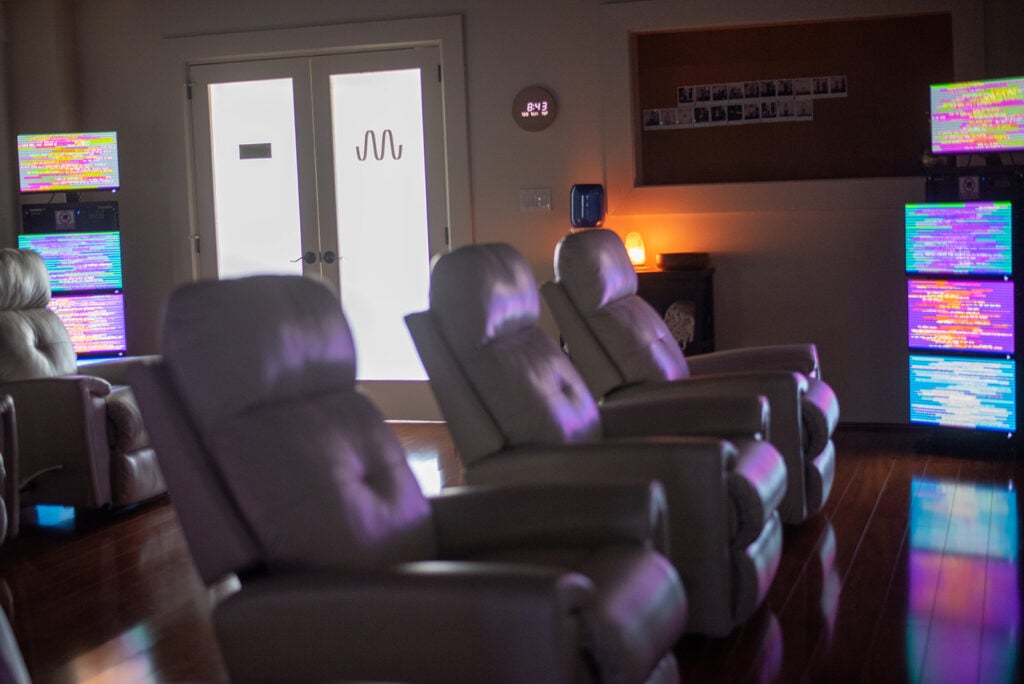
Maybe a friend told you about it. Maybe you came across a video or have been doing a little research of your own. However you found your way here, you’re probably curious — and maybe a little skeptical too. What exactly is happening in a room full of screens, and is there really something to it?
It’s a fair question. Here’s what we know, what the research suggests, and what we’re still learning.
First: “work” means three different things
People asking does the EESystem work are usually asking one of three questions, and they have three different answers.
- Does mainstream science support this technology? Not yet. Research specific to this technology is still limited.
- Is there anything published at all? A little. Less than proponents imply, more than skeptics assume.
- Do people consistently report getting something real out of it? Yes, and remarkably consistently.
Most content on this topic blurs those three together. We’d rather take them one at a time.
What the research does and doesn’t show
The research around scalar-field technology is still developing. While there are intriguing studies and areas worth exploring, we also recognize that the science is not yet conclusive. We’re interested in what’s being discovered while staying honest about what is still unknown.
There is one published study we think is worth exploring more closely. We’ll walk you through what was studied, what the researchers found, and the limitations worth keeping in mind so you can understand the research for yourself.
A four-year-old girl, and a seizure log
In August 2012 the Journal of Neurology Research published a case report by three researchers from the Department of Complementary and Alternative Medicine at the John A. Burns School of Medicine, University of Hawaiʻi.
Their patient was a four-year-old girl with autism and a three-year history of seizure disorder, diagnosed by her pediatric neurologist. She had been through tegretol, topamax, keppra, lamictal and micelene. The medication that controlled her seizures also, in the authors’ words, “at times caused excessive sedation.” Her parents were looking for a way to reduce both.
The paper records where she started in a single flat sentence:
FROM THE CASE REPORT
“At the time of the beginning of the EES treatment, she had not had a seizure-free day in two years.”
Six to eight generalised tonic-clonic seizures a day, each ten to twenty seconds long, plus eight to twelve shorter “drop” seizures. Her mother described a good day as “about 2 – 3 ‘grand mals’ daily, and 8 – 10 ‘drop’ seizures.”
She was asked to keep a written seizure log for a week before anything began, and to keep it going. That detail matters more than it sounds, and we’ll come back to it.
What the log recorded
The child sat, played, slept or ate in the scalar field for one to two hours, two or three times a week, with her mother present. Nothing touched her. Nothing was added to her treatment.
After the second session her mother noted fewer and shorter seizures. Then, on day four:
DAY FOUR
“After the third treatment the patient had a seizure-free day for the first time in a year and a half, according to her mother.”
By six months the tonic-clonic seizures had stopped. What remained were four to five brief partial seizures a day, one to two seconds each.
Dr. Sandra Rose Michael, who developed the technology, tells this case in her own words.
The two rows are different kinds of seizure. A generalised tonic-clonic seizure — the kind usually called a grand mal — involves the whole body stiffening and then jerking rhythmically; in this child they ran ten to twenty seconds. An atonic seizure is close to the opposite: muscle tone vanishes abruptly, which is why they are known as drop attacks, and hers lasted one to two seconds. The paper also uses “partial,” the older term for what is now called a focal seizure, meaning one that begins in a single area of the brain rather than across both at once. The Epilepsy Foundation’s guide to seizure types sets all of them out plainly.
So the two rows are not interchangeable, and a count that merges them will always look higher than the paper’s. What changed most is the row that mattered most: the long, whole-body seizures.
Why this one is harder to dismiss than most
Most wellness “evidence” collapses the moment you ask three questions. This case survives more of them than we expected, and it’s worth being specific about why.
- The baseline was recorded before treatment started. The mother was logging seizures for a week beforehand, so the “before” figure isn’t a memory reconstructed after a good outcome.
- The medication never changed. The authors state it plainly: “During the course of treatment and thereafter, there was no change in her medication.” Nothing was added that could explain the drop.
- Placebo is a weak explanation here. As the authors put it, “placebo effect is unlikely in a child who is unaware of the treatment.” A four-year-old playing with toys in a room has no expectation to fulfil.
- It held. Not a good fortnight. Six months later the tonic-clonic seizures were still absent.
- No adverse effects were observed over the whole period.
And here is what’s still to be desired
It is one child. One. There is no control group, no blinding, no second patient. A single case cannot establish that a treatment works; at best it establishes that something happened worth investigating properly. The authors say so themselves, and end the paper by calling for the double-blind study that still hasn’t been done.
The authors raise the alternative explanation and can’t rule it out. Children’s seizure patterns change as they age and the brain myelinates. They argue spontaneous remission is unlikely in a child with documented autism and medication-resistant seizures — but “unlikely” is not “excluded.”
So: a genuine, peer-reviewed, carefully documented single case. That is neither nothing, nor proof. Read it yourself — it’s open access and about four pages.
Ludlum NA, Shintani T, Harrigan R. Scalar Field Therapy and Mitigation of Seizure Disorder: A Case Report. J Neurol Res. 2012;2(4):172–175. doi:10.4021/jnr.v2i4.134
IF YOU’RE READING THIS BECAUSE OF YOUR OWN CHILD
We know how this page finds people. If your child has a seizure disorder and you’ve just read the paragraphs above, please take this part seriously.
One published case is not a reason to change anything about your child’s care. In that report the medication was never reduced, and the authors are explicit that it is not a cure. Do not stop or lower an anti-seizure medication — withdrawal can trigger seizures far worse than the ones being treated. That decision belongs with your child’s neurologist and nobody else.
We’re a restorative wellness space on Maui, not a clinic. We can share what the experience is like and what others have noticed, but we can’t promise a particular outcome for your child. If you’d like to talk it through before booking, text us. We’ll be open and honest with you.
We keep the other source documents on our research page so you can read them and form your own view, rather than take our summary of them on trust. Most of that material is single-patient or small-group work rather than controlled trials, and it should be read that way.
What guests actually report
This is where it stops being abstract. We’ve collected dozens of guest accounts, full names, real people, most of them local. Read them in full there. What’s striking isn’t any single dramatic story; it’s how much the ordinary ones rhyme. Four themes come up again and again.
SLEEP — MORE THAN ANY OTHER SINGLE THING
“I also had the best night of sleep after my first session.” — Kristina M.
A NERVOUS SYSTEM THAT FINALLY DOWNSHIFTS
“I’ve noticed my nervous system has now switched more easily into rest and digest instead of fight or flight.” — Stacey L.
MENTAL QUIET
“The constant chatter in my head seemed to have subsided.” — Tina M.
“It was like all the stressors my body is constantly dealing with disappeared. I left that night totally present and at peace.” — Nykki H.
SURPRISE AT HOW FAR UNDER THEY WENT
“My two hours seemed to be only minutes as I instantly fell into a state of relaxation and a deep sleep.” — Robbyne L.
Some guests describe much more than this. Those accounts are theirs to tell and you’ll find them on the testimonials page, in their own words. We won’t repeat them as claims of what this technology does, because that’s not a promise we can make to you, and setting you up to expect a miracle is the fastest way to make a genuinely good experience feel like a disappointment.
“My sleep tracker recorded some of my best sleep quality in months.” — a holistic wellness practitioner from the local guide Maui Makai, who spent an overnight session in our room and wrote about her experience.
Keeping Expectations Grounded
We’re excited about this technology and deeply value the experiences people share with us. At the same time, there are claims we’re simply not comfortable making. We’d rather be clear about what’s known, what’s still being explored, and leave room for you to have your own experience.
- The EESystem is not a medical device. It is not intended to diagnose, treat, cure, or prevent any disease or condition.
- We won’t tell you it will fix a specific health problem. We don’t know that, and neither does anyone else.
- We won’t tell you to stop seeing your doctor or change any treatment. Please don’t.
- We won’t tell you you’ll feel something dramatic. Some people do. Plenty of people just feel deeply rested, and that’s a completely normal outcome.
Our owners opened this room after a health challenge in their own family. We understand how deeply people want answers when someone they love is struggling, which is why we’re careful not to offer certainty where it doesn’t yet exist.
“What if I don’t feel anything?“
Common, and worth answering honestly rather than explaining away.
Some people notice a distinct tingle or ripple in the first few minutes. Others describe feeling sensation or energy in a particular area of the body. Some feel nothing unusual at all and simply fall asleep. Many people notice just how deeply relaxed they feel afterward.
Interestingly, what guests often share with us isn’t something they noticed during the session at all — it’s how they slept that night or how they felt the next morning.
If you find yourself trying to figure out whether something is “happening,” see if you can let that go. We have relaxing music and guided meditations available, or you can simply close your eyes, settle in, and give yourself permission to rest. You don’t need to monitor the experience or make anything happen.
How to decide for yourself
Does the EESystem work for you? Ultimately, your own experience is something we can’t predict. We can share what we know, what others have experienced, and where the research stands — then leave it to you to decide whether you’d like to experience it for yourself.
- Book two hours. One hour isn’t really enough time for most nervous systems to downshift.
- Close your eyes. Resting with your eyes closed is genuinely part of it, and it’s the single most common piece of advice returning guests give first-timers.
- Notice your sleep that night, not just how you feel walking out. That’s where most people report the clearest difference.
- Then judge. One session, $54, and the opportunity to experience it for yourself. Come with curiosity, rest for a while, and see what you notice.
Maybe you leave having simply enjoyed two quiet hours and a good nap. Maybe you notice something that makes you curious to come back. Either way, you get to decide what the experience means for you.
Frequently asked questions
Is there scientific proof the EESystem works?
No. Independent peer-reviewed research on scalar-field technology specifically is limited. There is one published case report we cite directly, plus case-study material on our research page. What is well established is that extended deep rest supports sleep, stress and mood.
Is the EESystem Legitimate?
If you’ve found yourself searching “Is the EESystem a scam?” you’re not alone. It’s a reasonable question when you’re encountering a technology you may not have heard of before — especially when some of the claims surrounding it can sound extraordinary.
The EESystem is an established technology used in more than 500 centers around the world, and many people report meaningful experiences with it. Where we encourage discernment is around the claims being made. The research is still developing, and we believe it’s important to be cautious of anyone promising specific health outcomes or presenting those outcomes as guaranteed.
What does the EESystem actually feel like?
Most guests describe deep relaxation, often falling asleep. Some notice a tingling or rippling sensation early on. Many report their clearest effect is sleep quality that night. See what a session is like.
Does the EESystem work right away, or does it take time?
Most people have a clear opinion after one two-hour session, judged on how they sleep that night. Guests who use it regularly tend to describe effects that build. Full pricing and packages are on our booking page.
Does the EESystem cure illness?
No. It is not a medical device and makes no claim to diagnose, treat, cure, or prevent any disease. It’s a complementary wellness practice, not a substitute for medical care.
Test it yourself
One session, two hours, and your own honest read. That’s a better standard than anyone’s marketing, including ours.
BOOK A SESSIONDisclaimer: Results may vary. Information and statements made are for educational purposes and are not intended to replace the advice of your doctor. The Energy Enhancement System™ and Maui Scalar Room do not dispense medical advice, prescribe, treat, cure, or diagnose illness. If you have a medical condition or health concern, see your physician.